
















THE NEW TEXAS PROCESS SERVER HANDBOOK
Practical guidance for starting your career, serving documents, documenting attempts, and avoiding costly mistakes.
132 pages • 21 chapters • Field checklists • Knowledge checks • Immediate access • No payment required.
TEXAS FIELD EXPERIENCE
Guidance developed from real Texas process-service fieldwork.
21 PRACTICAL CHAPTERS
From certification and intake through affidavits and business operations.
COURT-READY DOCUMENTATION
Field notes, status reports, returns, affidavits, and due diligence.
TEXAS FIELD CHECKLISTS
Practical steps to review before, during, and after each assignment.
INSTANT FREE PDF DOWNLOAD
Download the complete handbook for immediate reference.
A PRACTICAL GUIDE FOR NEW TEXAS PROCESS SERVERS
Process service involves far more than arriving at an address and handing someone a set of documents. Every assignment requires preparation, judgment, professional communication, accurate observation, and documentation that may later be reviewed by an attorney, court clerk, judge, opposing counsel, certification authority, or disciplinary investigator.
The New Texas Process Server Handbook was created as a practical field guide for people entering the profession. It explains what a new server should know before accepting an assignment, what to do in the field, what facts must be documented, and which common mistakes can damage a case or a professional reputation.
This is not an academic civil-procedure textbook. It is a readable, field-focused reference built to help new servers develop reliable habits from the first assignment, the first attempt, and the first return.
WHAT YOU’LL LEARN
Texas Certification and Professional Responsibility
Understand the basic certification path, the limits of a process server’s authority, continuing professional responsibilities, and the importance of checking current JBCC requirements.
Assignment Intake and Preparation
Learn how to review documents, identify the correct service target, confirm addresses and deadlines, organize packets, and obtain clarification before entering the field.
Safe and Professional Service Attempts
Plan reasonable attempts, approach residences and businesses professionally, recognize safety risks, and document access problems without escalating an encounter.
Identity, Communication, and Delivery
Use facts—not assumptions—to establish identity, communicate clearly, handle refusals, and accurately record how delivery was completed or why it was not completed.
Field Notes and Court-Ready Records
Build field notes that support accurate client updates, returns, affidavits, reports of non-service, exhibits, and later testimony.
Difficult Assignments
Prepare for evasive defendants, apartments, gated communities, secured buildings, hospitals, correctional facilities, subpoenas, and assignments involving special instructions.
FIELD-READY FEATURES
132 PRACTICAL PAGES
Clear, practical guidance for quick reference before and after assignments.
21 DETAILED CHAPTERS
Step-by-step instruction covering certification, field service, documentation, and professional practice.
ORGANIZED SECTIONS
A structured learning path from entering the profession through business operations.
READY CHECKLISTS
Practical reminders, operational rules, mistake warnings, and knowledge checks.
TEMPLATES
Field-note templates, sample status updates, checklists, and professional resources.
EXPLORE THE HANDBOOK
Part I — Entering the Profession
Learn how Texas certification works, understand what a process server is—and is not—and review the documents before leaving for an assignment.
Part II — Preparing and Making the Attempt
Build a controlled intake process, plan effective attempts, approach locations safely, establish identity, complete delivery, and handle residential and business service.
Part III — Documentation and Court-Ready Work
Create reliable field notes, preserve photographs and observations, prepare returns and affidavits, and understand the server’s role in due diligence and alternative service.
Part IV — Difficult Assignments
Address evasive defendants, secured properties, sensitive locations, subpoenas, and assignments requiring special instructions.
Part V — Professional Practice
Develop safer field habits, work effectively with law firms and process-serving companies, manage client expectations, and build a dependable service operation.
Appendices
Practical checklists, field-note templates, sample status updates, and a professional resource list.
FIELD-READY FEATURES
The handbook includes recurring features designed to turn information into action.
FIELD RULES
Memorable operational principles to apply before, during, and after each assignment.
COMMON MISTAKES
Preventable errors that commonly cause delays, confusion, or unreliable service records.
STOP & CONFIRM
Situations requiring the server to pause and request written client clarification.
HOUSTON INSIGHTS
Field-based guidance for apartments, businesses, secured properties, and sensitive locations.
ABOUT THE AUTHOR
Oleg Molchanov
Founder, Houston Process Servers, LLC
JBCC Certified Texas Process Server
NAPPS Member
TPSA Member
Oleg Molchanov is the Founder of Houston Process Servers, LLC and a JBCC Certified Texas Process Server serving the Houston legal community. His work includes routine, rush, same-day, and custom process service; difficult residential and business assignments; service in hospitals and correctional facilities; due-diligence documentation; court-ready affidavits; and locate research for law firms.
Through years of field work in Harris, Fort Bend, and Montgomery Counties, Oleg has learned that successful service depends on more than locating a door and handing over papers. It requires preparation, patience, accurate observation, professional communication, strict compliance with instructions, and documentation that an attorney can confidently place before a court.
He created this handbook to give new Texas process servers the practical guidance he believes every server should receive before accepting a first assignment.
FREQUENTLY ASKED QUESTIONS
Is The New Texas Process Server Handbook free?
Yes. The complete PDF is available as a free download. No payment is required.
Who is the handbook written for?
It is primarily written for people entering the Texas process-serving profession and recently certified servers who want practical, field-ready guidance. It can also help experienced servers review procedures and help legal professionals better understand the field-service and documentation process.
Is this handbook legal advice?
No. The handbook is educational material and does not provide legal advice or create an attorney-client relationship. Readers must verify current requirements and follow the applicable rules, court orders, issuing documents, and written client instructions.
Does the handbook explain Texas process-server certification?
Yes. The handbook describes the general certification path and the professional responsibilities associated with certification. Because requirements can change, applicants and certified servers should always verify current information directly with the Judicial Branch Certification Commission.
Does it include information about Texas Rule 106 and alternative service?
Yes. The handbook explains the process server’s role in documenting unsuccessful attempts, supporting due diligence, and following the exact terms of a signed alternative-service order. It does not tell servers to select or improvise a method of alternative service.
Does the handbook include field checklists?
Yes. Chapters include field rules, common-mistake warnings, stop-and-confirm situations, practical checklists, and knowledge checks.
Can a process-serving company use it for training?
The handbook can serve as an educational supplement for orientation and discussion. Each company should still maintain its own written procedures, supervision, quality-control standards, and current legal and certification resources.
When was the handbook last reviewed?
The 2026 Edition was reviewed using Texas court and JBCC materials available in August 2026. Rules, procedures, fees, and certification requirements may change, so readers should verify current information before acting.
OFFICIAL TEXAS PROCESS SERVER RESOURCES
Process-server requirements and court rules may change. Readers should verify current information through the Texas Judicial Branch Certification Commission and review the official Texas process-server statutes, rules, and resources.
This handbook is provided for educational and practical reference only. It does not constitute legal advice or replace current Texas law, court rules, local requirements, or instructions from the issuing attorney or court.
LEGAL AND UPDATE NOTICE
Copyright © 2026 Oleg Molchanov. All rights reserved.
This handbook is an educational field guide. It is not legal advice and does not create an attorney-client relationship. Texas statutes, court rules, local practices, certification requirements, fees, and administrative procedures can change. Readers must verify current requirements with the Judicial Branch Certification Commission, the Texas Rules of Civil Procedure, the issuing court, and the attorney or law firm that assigned the service.
A process server should never improvise a method of service, alter court documents, interpret legal rights for a recipient, or claim authority the server does not possess. When instructions are unclear, stop and obtain written clarification from the client or issuing court.
Last reviewed: August 2026
OUR BLOG

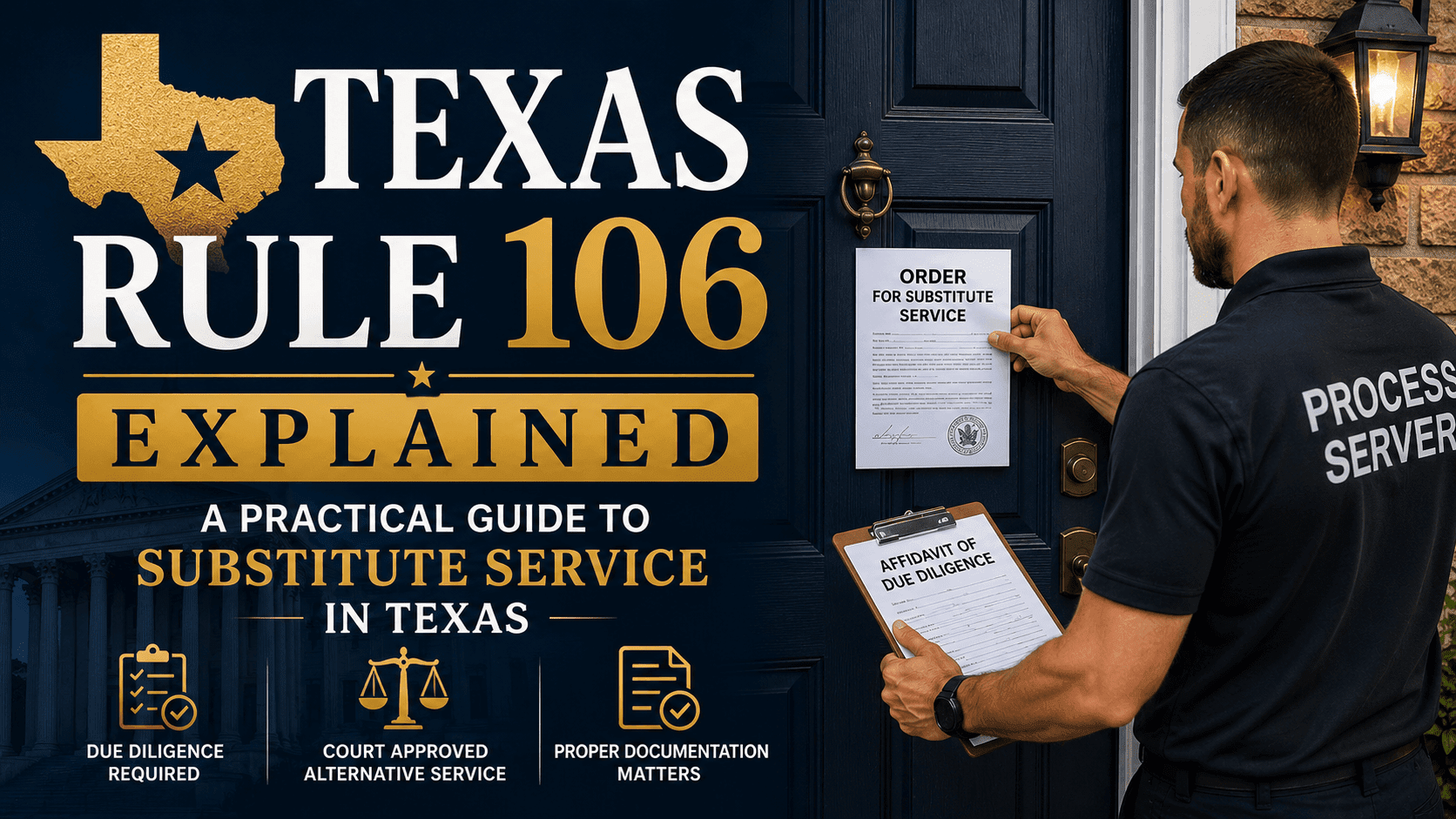
Texas Rule 106 Explained: Complete Guide to Substitute Service in Texas
Texas Rule 106 Explained: A Practical Guide to Substitute Service in Texas Texas Rule 106 Explained: When a defendant evades service, refuses to answer the door, or cannot be personally served after several attempts, Texas Rule 106 provides a possible remedy. If a defendant avoids service, refuses to answer the door, or cannot be personally served after multiple attempts, Texas

Serving Someone Court Papers in Houston: 7 Critical Facts You Must Know
Serving Someone Court Papers in Houston, TX: What You Need to Know Serving someone court papers in Houston, Texas means officially delivering legal documents—such as lawsuits, subpoenas, or citations—in a way that complies with Texas Rules of Civil Procedure. Proper service makes certain that the court has jurisdiction, that all parties receive notice, and that due process is protected. Serving

Top Myths About Process Servers — Debunking Process Service Misconceptions
Top Myths About Process Servers — Debunking Process Service Misconceptions A practical guide for Houston attorneys and legal teams, designed to clarify common misconceptions and support effective litigation. Understanding the realities of civil process serving is essential for any Houston law firm. Unfortunately, misconceptions about service of process can lead to delays, unrealistic client expectations, and unwarranted complications in litigation.

Cost Breakdown: Houston process server prices 2026
Cost Breakdown for Process Serving in Houston: A Practical Guide for Attorneys & Collection Agencies For law firms and collection agencies, understanding Houston process server prices is essential for accurate budgeting, deadline management, and compliance. Unlike flat-rate services used by the general public, professional civil process serving for legal practitioners often requires a more detailed cost breakdown due to specific

Legal Services As Easy As ABC : Same-Day Process Serving You Can Count On
Service of Process Explained Easiest as ABC: Your Guide to Legal Services When you hear terms like “service of process,” it can feel overwhelming. Legal jargon can be confusing, but the concept is straightforward. In simple terms, service of process is the formal way of notifying a person or business that they are being sued or that a legal matter

Demand Letter Delivery: 7 Critical Facts You Must Know Today!
Demand Letter Delivery: 3 Key Reasons It’s More Effective Than Certified Mail When a client or customer owes you money and still won’t respond, it can be frustrating and costly. A professionally served demand letter can help resolve disputes without the hassle and expense of going to court. But a demand letter is only as effective as its delivery—and that’s

Process Server for Restraining Order in Houston: 10 Key Rules to Follow
Process Server for Restraining Order in Houston: 10 Key Rules to Follow When someone files for a restraining order in Texas, they must ensure the respondent is officially notified. This is done through legal service, and in most cases, a certified process server handles this critical task. What Is a Restraining Order? A restraining order is a court-issued directive designed

How to Find a Reliable 24-Hour Process Server in Houston?
How to Find a Reliable 24-Hour Process Server in Houston, Texas When legal deadlines are urgent, a standard process-serving company may not suffice. A 24-hour process server is essential for timely service. At Houston Process Servers, LLC, we recognize that legal matters often require action outside regular business hours. Our team offers around-the-clock and same-day process service to keep your

What Is Subpoena Duces Tecum? 10 Things Everyone Must Know
What Is Subpoena Duces Tecum? What Is a Subpoena and How Is It Delivered? A subpoena is a legal document that orders someone to appear in court or produce evidence. A subpoena duces tecum specifically commands a person to deliver documents or records. To serve a subpoena or deliver a subpoena properly, professional process servers ensure legal procedures are followed,