








TEXAS RULE 106 ATTORNEY QUICK REFERENCE GUIDE
A concise field reference for Texas attorneys seeking substituted service after diligent but unsuccessful attempts.
Understand the documentation, affidavit details, and supporting evidence that can help establish a clear record for the court.
PRACTICAL RULE 106 GUIDANCE
TEXAS RULE 106 OVERVIEW
A concise explanation of when substituted service may become appropriate.
DOCUMENTATION CHECKLIST
Key records that can help demonstrate diligent service attempts.
COMMON DENIAL RISKS
Frequent weaknesses that may undermine a motion for substituted service.
ATTORNEY FILING CHECKLIST
A practical reminder of documents commonly submitted with the motion.
FREE PDF DOWNLOAD
Download the complete four-page guide for immediate reference.
A PRACTICAL RULE 106 GUIDE FOR TEXAS ATTORNEYS
Texas Rule of Civil Procedure 106 permits a court to authorize an alternative method of service when the motion is supported by evidence showing that ordinary service methods have been unsuccessful.
The Texas Rule 106 Attorney Quick Reference Guide helps attorneys and legal teams understand the field documentation that may support a motion for substituted service.
It provides a concise overview of diligent attempts, address verification, field observations, affidavits, proposed service methods, and proof of service.
WHAT YOU’LL LEARN
What The Court Needs To See
Learn which facts can help demonstrate diligent attempts, connect the defendant to the address, and show why the requested service method is reasonably likely to provide notice.
When Rule 106 May Apply
Review when unsuccessful personal or certified-mail service may lead counsel to consider requesting substituted service.
How To Document Diligence
Understand the value of attempts on different days and at different times, along with complete notes describing every relevant observation.
What Evidence May Help
Learn how address verification, occupancy indicators, vehicle information, photographs, returned mail, and other supporting facts may strengthen the record.
Why Motions May Be Denied
Identify common weaknesses, including too few attempts, repetitive attempt times, incomplete affidavits, insufficient address evidence, and a proposed method unsupported by the facts.
How The Process Works
Follow the general sequence from attempted service and field documentation through the affidavit, motion, court order, alternative service, and return.
BUILT FOR ATTORNEYS AND LEGAL TEAMS
INSIDE THE GUIDE
Understanding Rule 106
A practical overview of substituted service, supporting documentation, commonly authorized alternatives, and the importance of demonstrating that the proposed method is reasonably likely to provide notice.
Winning Rule 106 Motions
A field-focused summary of common denial risks, recommended documentation practices, the Rule 106 workflow, and an attorney filing checklist.
Documentation Checklist
The guide highlights records that may support the motion:
- Attempts made on different days and at different times
- Detailed field observations
- Address and occupancy verification
- Vehicle or property observations
- Photographs when appropriate
- Returned or unclaimed mail information
- A comprehensive affidavit of attempted service
Attorney Filing Checklist
A convenient reminder of materials that may accompany a Rule 106 request:
- Motion for substituted service
- Supporting affidavit
- Proposed order
- Relevant exhibits
- Photographs and field notes
- Address-verification information
Oleg Molchanov
Founder, Houston Process Servers, LLC
JBCC Certified Texas Process Server
NAPPS Member
TPSA Member
Oleg Molchanov is the Founder of Houston Process Servers, LLC and a JBCC Certified Texas Process Server serving the Houston legal community. His work includes routine, rush, same-day, and custom process service; difficult residential and business assignments; service in hospitals and correctional facilities; due-diligence documentation; court-ready affidavits; and locate research for law firms.
Through years of field work in Harris, Fort Bend, and Montgomery Counties, Oleg has learned that successful service depends on more than locating a door and handing over papers. It requires preparation, patience, accurate observation, professional communication, strict compliance with instructions, and documentation that an attorney can confidently place before a court.
He created this handbook to give new Texas process servers the practical guidance he believes every server should receive before accepting a first assignment.
COURT-READY FIELD DOCUMENTATION
A Rule 106 motion depends on more than showing that the defendant was not served. The record should explain what was attempted, when each attempt occurred, what the process server observed, and why the requested alternative method is reasonably likely to provide notice.
Houston Process Servers, LLC provides detailed documentation intended to help counsel evaluate the next procedural step.
Our Rule 106 support may include:
- Multiple attempts on different days and at varied times
- Detailed notes for every attempt
- Address and occupancy observations
- Vehicle and property information when relevant
- Photographs when appropriate and legally permissible
- Prompt status updates
- A comprehensive affidavit of attempted service
- Service completed according to the signed court order
THE RULE 106 SERVICE PROCESS
ATTEMPT SERVICE
Conduct multiple personal-service attempts on different days of the week and at varied times of day (including mornings, afternoons, evenings, and weekends when appropriate) to demonstrate reasonable diligence and avoid repetitive or predictable patterns.
DOCUMENT ATTEMPTS
Record detailed, time-stamped notes for each attempt, including date, exact time, access conditions (gated entry, locked doors, restricted access), vehicle presence, occupancy indicators (lights, noise, movement), conversations with occupants or neighbors, and any other relevant observations that may help establish residence or evasion.
PREPARE THE AFFIDAVIT
Prepare a clear, fact-based affidavit describing all diligence efforts, explaining why traditional service methods were unsuccessful, and setting out specific facts that connect the defendant to the service address, including observations, verification steps, and supporting field evidence.
FILE THE MOTION
Counsel files the motion for substituted service along with the supporting affidavit, proposed order, and all relevant exhibits such as field notes, photographs, address verification records, and any additional documentation supporting the request for alternative service.
COURT ORDER
The court determines whether alternative service is appropriate after reviewing the motion, supporting affidavit, and evidence of diligent attempts, and if granted, the court specifies the exact authorized method of service that must be followed in compliance with the order.
COMPLETE SERVICE
The process server executes service strictly in accordance with the signed court order, ensuring full compliance with all instructions, and then files the required proof of service confirming completion in the manner directed by the court.
COMMON REASONS RULE 106 MOTIONS MAY BE DENIED
TOO FEW ATTEMPTS
The record may not show sufficient diligence if the attempts are few, repetitive, or lack detail for court to find reasonable efforts before seeking substituted service.
REPETITIVE ATTEMPT TIMES
Attempts made repeatedly during the same narrow time period may provide an incomplete picture.
WEAK AFFIDAVIT DETAILS
General statements may not explain precisely what occurred during each attempt.
WEAK ADDRESS EVIDENCE
The motion may not adequately connect the defendant to the address where alternative service is requested.
SERVICE METHOD ISSUES
The requested method may not be supported by facts showing that it is reasonably likely to give the defendant notice.
FREQUENTLY ASKED QUESTIONS
What is substituted service under Texas Rule 106?
Substituted service is an alternative method of delivering citation authorized by the court when the requirements of Rule 106 are satisfied. The method must be stated in the signed court order and followed precisely.
Does Rule 106 require a fixed number of attempts?
Rule 106 does not establish one universal number of required attempts. The court evaluates the supporting evidence and the circumstances of the case. Varied, well-documented attempts generally create a more informative record than repetitive attempts.
What should the process server document?
The server should document the date, time, location, result, access conditions, occupancy indicators, relevant vehicles, conversations, photographs when appropriate, and any other facts related to the defendant or service address.
Can Rule 106 authorize service by email or social media?
A court may authorize electronic service or another method when the supporting evidence shows that the method is reasonably effective to provide notice. Electronic service should not be attempted unless it is specifically authorized by the court.
Who decides whether substituted service is appropriate?
The court makes that determination after reviewing the motion, supporting statement or affidavit, proposed method, and accompanying evidence.
Must the process server follow the order exactly?
Yes. Alternative service should be completed precisely as directed in the signed order. Material deviation from the order may create problems with the validity of service.
Is the guide free?
Yes. The complete Texas Rule 106 Attorney Quick Reference Guide is available as a free PDF download.
Does Houston Process Servers provide legal advice?
No. Houston Process Servers, LLC provides process service, field documentation, status reporting, and affidavits. Legal strategy, motion preparation, and interpretation of the rules remain the responsibility of counsel.
OFFICIAL TEXAS RESOURCES
Attorneys and legal professionals should confirm current requirements through the official Texas judicial resources:
LEGAL AND UPDATE NOTICE
This guide is provided for general educational and professional-reference purposes. It does not constitute legal advice, create an attorney-client relationship, or guarantee that a court will approve a particular motion or method of service.
Court practices and procedural requirements may vary. Attorneys should review the current Texas Rules of Civil Procedure, applicable statutes, local rules, standing orders, and the specific requirements of the assigned court before relying on this material.
OUR BLOG

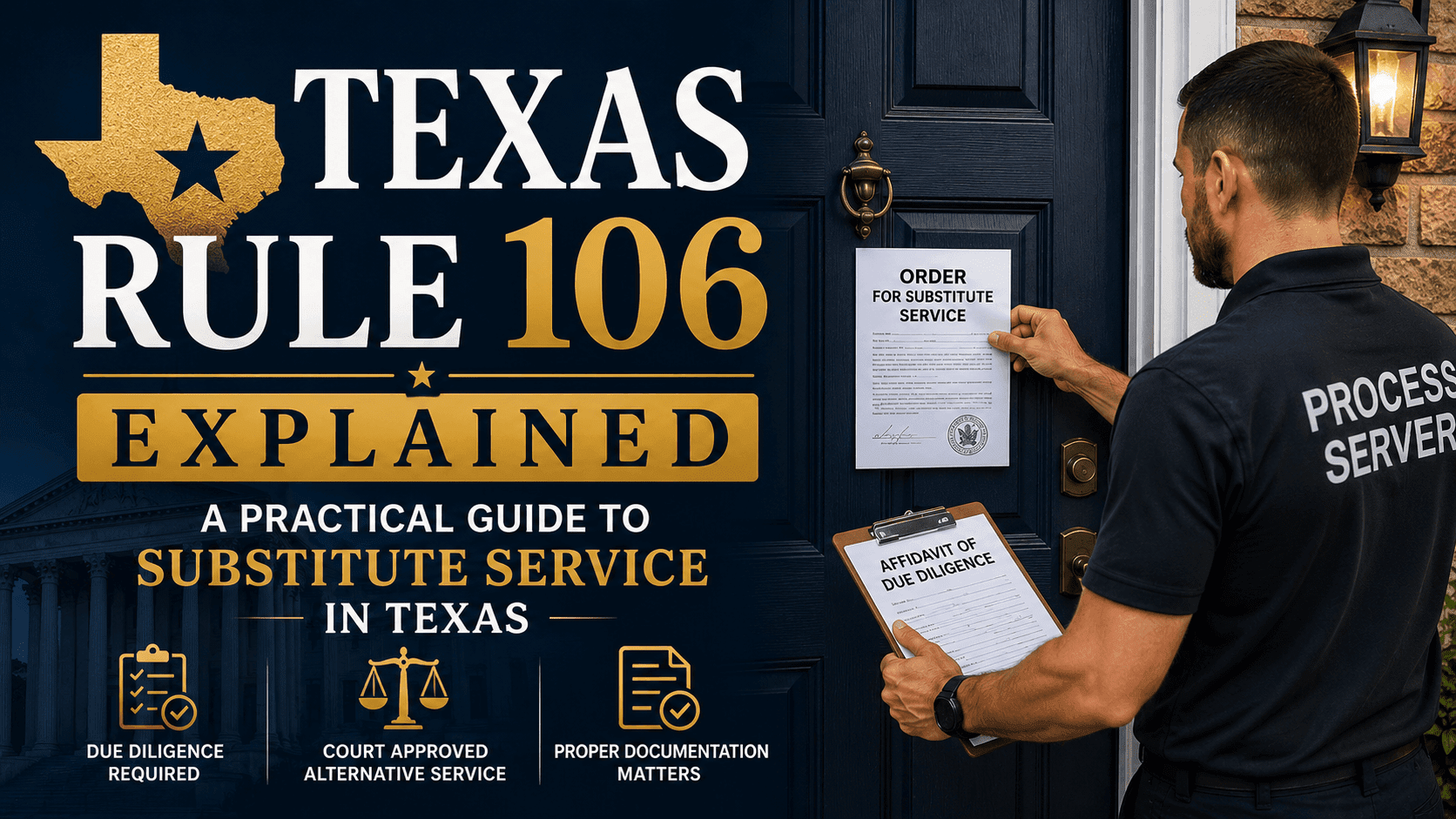
Texas Rule 106 Explained: Complete Guide to Substitute Service in Texas
Texas Rule 106 Explained: A Practical Guide to Substitute Service in Texas Texas Rule 106 Explained: When a defendant evades service, refuses to answer the door, or cannot be personally served after several attempts, Texas Rule 106 provides a possible remedy. If a defendant avoids service, refuses to answer the door, or cannot be personally served after multiple attempts, Texas

Serving Someone Court Papers in Houston: 7 Critical Facts You Must Know
Serving Someone Court Papers in Houston, TX: What You Need to Know Serving someone court papers in Houston, Texas means officially delivering legal documents—such as lawsuits, subpoenas, or citations—in a way that complies with Texas Rules of Civil Procedure. Proper service makes certain that the court has jurisdiction, that all parties receive notice, and that due process is protected. Serving

Top Myths About Process Servers — Debunking Process Service Misconceptions
Top Myths About Process Servers — Debunking Process Service Misconceptions A practical guide for Houston attorneys and legal teams, designed to clarify common misconceptions and support effective litigation. Understanding the realities of civil process serving is essential for any Houston law firm. Unfortunately, misconceptions about service of process can lead to delays, unrealistic client expectations, and unwarranted complications in litigation.

Cost Breakdown: Houston process server prices 2026
Cost Breakdown for Process Serving in Houston: A Practical Guide for Attorneys & Collection Agencies For law firms and collection agencies, understanding Houston process server prices is essential for accurate budgeting, deadline management, and compliance. Unlike flat-rate services used by the general public, professional civil process serving for legal practitioners often requires a more detailed cost breakdown due to specific

Legal Services As Easy As ABC : Same-Day Process Serving You Can Count On
Service of Process Explained Easiest as ABC: Your Guide to Legal Services When you hear terms like “service of process,” it can feel overwhelming. Legal jargon can be confusing, but the concept is straightforward. In simple terms, service of process is the formal way of notifying a person or business that they are being sued or that a legal matter

Demand Letter Delivery: 7 Critical Facts You Must Know Today!
Demand Letter Delivery: 3 Key Reasons It’s More Effective Than Certified Mail When a client or customer owes you money and still won’t respond, it can be frustrating and costly. A professionally served demand letter can help resolve disputes without the hassle and expense of going to court. But a demand letter is only as effective as its delivery—and that’s

Process Server for Restraining Order in Houston: 10 Key Rules to Follow
Process Server for Restraining Order in Houston: 10 Key Rules to Follow When someone files for a restraining order in Texas, they must ensure the respondent is officially notified. This is done through legal service, and in most cases, a certified process server handles this critical task. What Is a Restraining Order? A restraining order is a court-issued directive designed

How to Find a Reliable 24-Hour Process Server in Houston?
How to Find a Reliable 24-Hour Process Server in Houston, Texas When legal deadlines are urgent, a standard process-serving company may not suffice. A 24-hour process server is essential for timely service. At Houston Process Servers, LLC, we recognize that legal matters often require action outside regular business hours. Our team offers around-the-clock and same-day process service to keep your

What Is Subpoena Duces Tecum? 10 Things Everyone Must Know
What Is Subpoena Duces Tecum? What Is a Subpoena and How Is It Delivered? A subpoena is a legal document that orders someone to appear in court or produce evidence. A subpoena duces tecum specifically commands a person to deliver documents or records. To serve a subpoena or deliver a subpoena properly, professional process servers ensure legal procedures are followed,