

















TEXAS SHERIFFS’ & CONSTABLES’ PROCESS SERVICE FEES

A 2026 LAWYER’S GUIDE TO ALL 254 TEXAS COUNTIES

Find reported sheriffs’ and constables’ civil-process fees in one searchable statewide reference.

top 254 counties
254 COUNTIES

Browse every Texas county in one directory.

top county search
COUNTY SEARCH

Find reported fees by county name.

top zip search
ZIP SEARCH

Locate possible counties by ZIP code.

top process search
PROCESS SEARCH

Search citation, writ, order, and more.

top fee details
FEE DETAILS

Review amounts, conditions, and notes.

A PRACTICAL TEXAS PROCESS-SERVICE FEE REFERENCE

Texas process service fees by county can vary based on the receiving office, document type, mileage, copies, and local payment requirements. Texas attorneys frequently need to compare county process-service charges, identify the correct serving office, estimate filing-related expenses, or determine whether a sheriff, constable, or private process server is appropriate for a particular assignment.

The difficulty is that Texas has 254 counties, and public fee information may be reported under different names, categories, conditions, or local instructions.

This guide brings the reported information into one attorney-focused directory. Instead of searching county websites individually, readers can begin with a county name or ZIP code, review the available entries, and then confirm the current amount and service requirements directly with the receiving office.

WHAT THE GUIDE INCLUDES

Cover of the 2026 Texas Process Service Sheriffs’ and Constables’ Fees lawyer’s guide by Oleg Molchanov
All 254 Texas Counties

County sections are arranged alphabetically from Anderson County through Zavala County for fast reference.

Searchable Zip-code References

The PDF contains searchable ZIP-code text. Use Ctrl+F on Windows or Command+F on Mac and enter a five-digit ZIP code to locate possible county matches.

Searchable Document And Process Types

Search the full PDF for the name of a document or process. Useful search terms may include citation, subpoena, summons, motion, notice, order, writ, garnishment, execution, attachment, sequestration, possession, or order of sale. Results depend on the terminology used in the reported source records.

Reported Civil-process Fees

The directory preserves reported fee entries associated with citations, subpoenas, notices, writs, orders, sales, executions, attachments, and other process-related categories appearing in the source data.

Conditions And Review Notes

Where available, the guide includes reported comments, service conditions, mileage references, deposits, hourly charges, or other notes that may affect the total amount.

Alphabetical Index And PDF Bookmarks

The county index and built-in PDF bookmarks allow attorneys and legal staff to move directly to the relevant county section.

FIELD-READY FEATURES

field county
COUNTY INDEX

Browse all counties alphabetically.

field zip lookup
ZIP LOOKUP

Find possible counties by ZIP.

field process type
PROCESS TYPE

Search citation, writ, order, and more.

field fee notes
FEE NOTES

Review charges and reported conditions.

field pdf bookmarks
PDF BOOKMARKS

Jump directly to county sections.

EXPLORE THE GUIDE

Cover of the 2026 Texas Process Service Sheriffs’ and Constables’ Fees lawyer’s guide by Oleg Molchanov
Search Three Ways

Search the PDF by county name, five-digit ZIP code, or document and process type using Ctrl+F on Windows or Command+F on Mac.

Review The Entry

Compare the reported fee, process category, office information, and any available conditions or review notes.

Check Every Match

Some ZIP codes cross county boundaries, and different offices may use different names for similar documents. Review every relevant result.

Confirm The Office

Determine whether the assignment belongs with a sheriff, constable, clerk, court, or another authorized office.

Verify Before Sending

Confirm the current fee, payment method, copies, original-document requirements, mileage, and service instructions before delivery.

869 Pages, Only 3 Mb

Access a comprehensive statewide reference in a lightweight, web-optimized PDF that is fast to download, easy to store, and convenient to search.

Use this Texas process service fees by county reference to compare reported fees, office requirements, payment information, and available service instructions before sending documents.

WHAT’S INSIDE THE GUIDE

869 pages
869 PAGES

Extensive statewide fee reference.

254 counties
254 COUNTIES

Every Texas county included.

sheriff fees
SHERIFF FEES

Reported county service charges.

constable fees
CONSTABLE FEES

Reported precinct fee information.

only 3mb
ONLY 3 MB

Lightweight, web-optimized PDF.

ABOUT THE AUTHOR

Oleg Molchanov HPS 3x4 1200x1600 1

Oleg Molchanov

Founder, Houston Process Servers, LLC
JBCC Certified Texas Process Server
NAPPS Member
TPSA Member

Oleg Molchanov is the founder of Houston Process Servers, LLC and a JBCC Certified Texas Process Server. Since establishing the company in 2018, he has remained personally involved in difficult, time-sensitive, and documentation-intensive assignments for law firms, businesses, and government agencies.

With eight years of Texas process-service experience, Oleg has handled thousands of assignments ranging from routine civil process to complex matters requiring detailed field observations, address verification, photographs, varied attempts, and court-ready documentation. His work includes Rule 106 diligence, corporate and registered-agent service, service on incarcerated individuals, and court-ready affidavits.

Oleg primarily serves Harris, Fort Bend, and Montgomery Counties while coordinating assignments throughout Texas. As a member of NAPPS and the Texas Process Servers Association, he emphasizes reliable communication, accurate reporting, and careful documentation. He created this searchable guide to give attorneys and legal staff a faster starting point for reviewing reported sheriffs’ and constables’ fees across all 254 Texas counties before confirming current requirements with the receiving office.

FREQUENTLY ASKED QUESTIONS

Does the guide cover every Texas county?

Yes. The directory includes sections for all 254 Texas counties, arranged alphabetically.

Can I search the PDF by ZIP code?

Yes. The ZIP-code references are searchable text. Use Ctrl+F on Windows or Command+F on Mac. Because ZIP codes may cross county boundaries, review every match and verify the county for the actual street address.

Are the listed amounts guaranteed to be current?

No. The guide compiles reported 2026 fee information from public source data. County and precinct schedules, payment requirements, mileage, deposits, and service instructions may change. Confirm all fees with the receiving office before relying on an amount.

Does a ZIP-code match establish the correct county?

No. A ZIP code is only a search aid. It does not establish jurisdiction or confirm the county for a specific street address.

Does the reported amount always represent the total cost?

Not necessarily. Some entries may be base fees, deposits, hourly rates, mileage charges, commissions, or individual components of a larger total.

Does the guide identify the correct constable precinct?

The guide organizes information primarily by county. Attorneys should confirm the correct precinct, office, and territorial jurisdiction before sending documents or payment.

Can Houston Process Servers coordinate service outside Greater Houston?

Houston Process Servers, LLC can assist with statewide Texas process-service coordination, subject to assignment requirements and server availability.

Does this guide provide legal advice?

No. The guide is provided for general professional reference. Legal strategy, interpretation of rules, selection of service methods, and compliance with court orders remain the responsibility of counsel.

How can attorneys search Texas process service fees by county?

Attorneys can search Texas process service fees by county name, five-digit ZIP code, or document type. Because fees and requirements may change, confirm the current information directly with the receiving sheriff’s or constable’s office before delivery.

OFFICIAL AND PUBLIC REFERENCE SOURCES

Readers should confirm current requirements through the appropriate official resources, including:

  • Texas Comptroller — Sheriffs’ and Constables’ Fees
  • Individual Texas sheriff and constable offices
  • County and precinct websites
  • District and county clerks
  • Texas Rules of Civil Procedure
  • Applicable statutes, local rules, standing orders, and signed court orders

LEGAL AND UPDATE NOTICE

This guide is provided for general educational and professional-reference purposes. It does not constitute legal advice, create an attorney-client relationship, guarantee the accuracy or completeness of a local fee schedule, or guarantee acceptance of process by a particular office.

Reported amounts and conditions may change. Some entries may represent components, deposits, mileage, hourly charges, commissions, or categories requiring additional review. Before relying on the guide, confirm the current fee, payment method, required copies, original-document requirements, jurisdiction, service instructions, and return procedure with the receiving office.

The sheriff depicted on the cover is an illustration and does not represent a specific officer or imply endorsement by any sheriff, constable, county, precinct, court, or public agency.

OUR BLOG

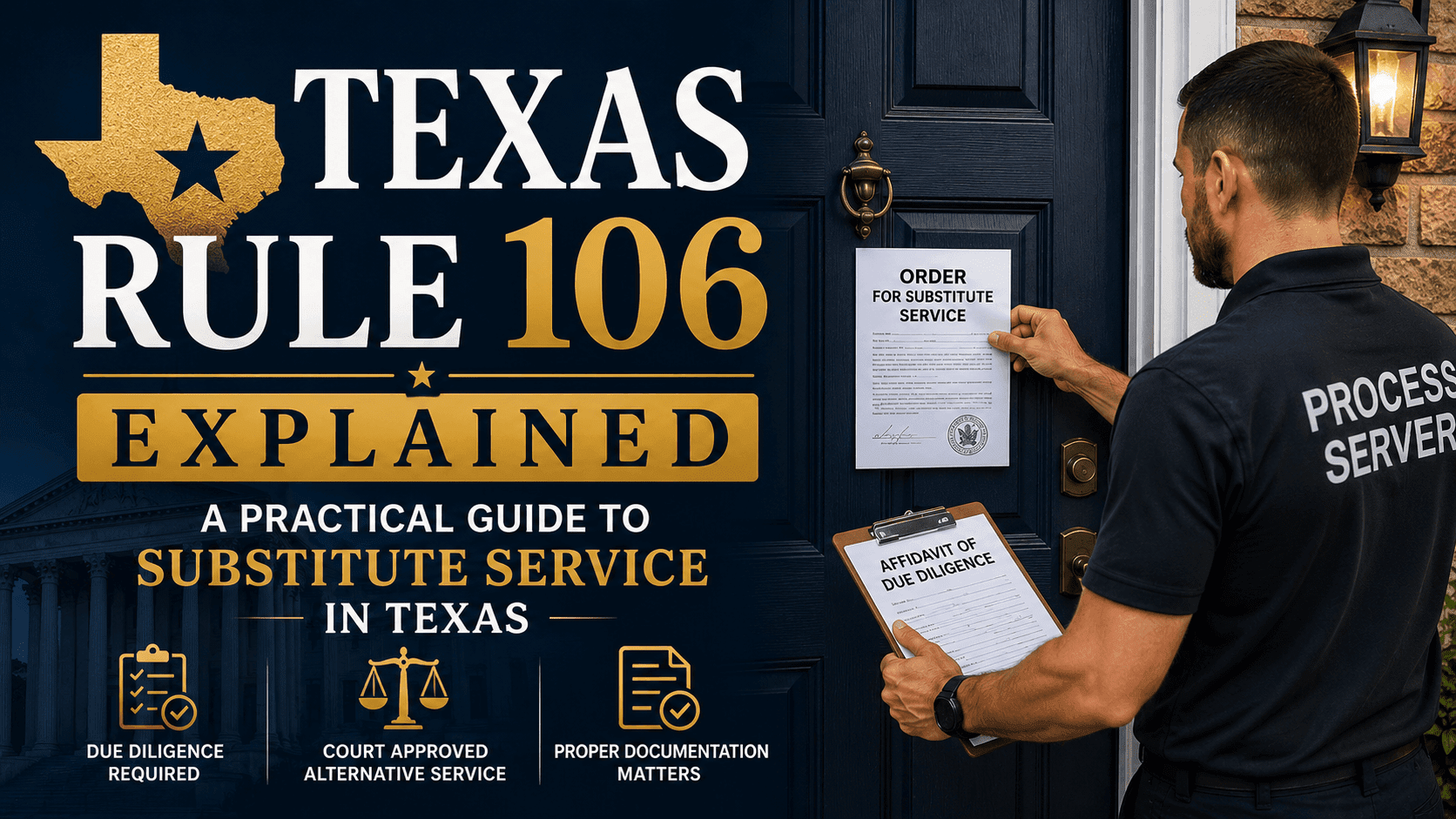
Texas Rule 106 explained showing substitute service of process in Texas by a professional process server posting legal documents at a residential property
Texas Rule 106 Explained: Complete Guide to Substitute Service in Texas

Texas Rule 106 Explained: A Practical Guide to Substitute Service in Texas Texas Rule 106 Explained: When a defendant evades service, refuses to answer the door, or cannot be personally served after several attempts, Texas Rule 106 provides a possible remedy. If a defendant avoids service, refuses to answer the door, or cannot be personally served after multiple attempts, Texas

Serving Someone Court Papers in Houston, TX
Serving Someone Court Papers in Houston: 7 Critical Facts You Must Know

Serving Someone Court Papers in Houston, TX: What You Need to Know Serving someone court papers in Houston, Texas means officially delivering legal documents—such as lawsuits, subpoenas, or citations—in a way that complies with Texas Rules of Civil Procedure. Proper service makes certain that the court has jurisdiction, that all parties receive notice, and that due process is protected. Serving

Professional process server holding legal documents in front of a courthouse illustrating common process service myths and legal misconceptions in Texas.
Top Myths About Process Servers — Debunking Process Service Misconceptions

Top Myths About Process Servers — Debunking Process Service Misconceptions A practical guide for Houston attorneys and legal teams, designed to clarify common misconceptions and support effective litigation. Understanding the realities of civil process serving is essential for any Houston law firm. Unfortunately, misconceptions about service of process can lead to delays, unrealistic client expectations, and unwarranted complications in litigation.

Houston process server prices 2026
Cost Breakdown: Houston process server prices 2026

Cost Breakdown for Process Serving in Houston: A Practical Guide for Attorneys & Collection Agencies For law firms and collection agencies, understanding Houston process server prices is essential for accurate budgeting, deadline management, and compliance. Unlike flat-rate services used by the general public, professional civil process serving for legal practitioners often requires a more detailed cost breakdown due to specific

Legal Services As Easy As ABC
Legal Services As Easy As ABC : Same-Day Process Serving You Can Count On

Service of Process Explained Easiest as ABC: Your Guide to Legal Services When you hear terms like “service of process,” it can feel overwhelming. Legal jargon can be confusing, but the concept is straightforward. In simple terms, service of process is the formal way of notifying a person or business that they are being sued or that a legal matter

Demand Letter Delivery in Houston, TX
Demand Letter Delivery: 7 Critical Facts You Must Know Today!

Demand Letter Delivery: 3 Key Reasons It’s More Effective Than Certified Mail When a client or customer owes you money and still won’t respond, it can be frustrating and costly. A professionally served demand letter can help resolve disputes without the hassle and expense of going to court. But a demand letter is only as effective as its delivery—and that’s

Process Server for Restraining Order in Houston, Texas. Deliver a Restraining Order. serve a Restraining Order
Process Server for Restraining Order in Houston: 10 Key Rules to Follow

Process Server for Restraining Order in Houston: 10 Key Rules to Follow When someone files for a restraining order in Texas, they must ensure the respondent is officially notified. This is done through legal service, and in most cases, a certified process server handles this critical task. What Is a Restraining Order? A restraining order is a court-issued directive designed

24-hour process server, same-day process servers, same-day process service, same-day processing company
How to Find a Reliable 24-Hour Process Server in Houston?

How to Find a Reliable 24-Hour Process Server in Houston, Texas When legal deadlines are urgent, a standard process-serving company may not suffice. A 24-hour process server is essential for timely service. At Houston Process Servers, LLC, we recognize that legal matters often require action outside regular business hours. Our team offers around-the-clock and same-day process service to keep your

What Is Subpoena Duces Tecum?
What Is Subpoena Duces Tecum? 10 Things Everyone Must Know

What Is Subpoena Duces Tecum? What Is a Subpoena and How Is It Delivered? A subpoena is a legal document that orders someone to appear in court or produce evidence. A subpoena duces tecum specifically commands a person to deliver documents or records. To serve a subpoena or deliver a subpoena properly, professional process servers ensure legal procedures are followed,

Scroll to Top